The Media Revolution, by Darrell West
Key Concepts: media revolution, , tabloidization, infotainment, Hollywoodization
Welcome to PS111 "Mass Media"
My name is Darrell West (Professor of Political Science and Director,
Today, I will give you an overview of the course
-discuss major themes
-fill you in on what we will be doing in this class
-show you how media affect culture, society, and politics
Thesis of this course is revolution
-unusual approach for course on American society and politics, so let me briefly discuss what I mean
-when you think of revolution, you generally think of large scale societal upheavals such as French Revolution, Russian Revolution, or American Revolution in 1776
-series of events that transformed the society and politics of the day
-I am going to argue in this class that what is happening with our contemporary media is akin to a revolution in the sense that there are broad-based changes taking place which in their cumulative impact are transforming how we acquire information
-these changes affect how we relate to one another, how our society and culture function, and the manner in which our political system operates
-some of changes we'll discuss are technological in nature (shift from radio and television to Internet delivery system)
-others are economic (degree of market competition faced by news organizations)
-still others refer to style of media coverage (rise of tabloid-style coverage)
-cumulative result of all these changes is a major transformation in our system
-by end of class, my goal is to show you how dramatically our media system is changing and what these changes mean for society and politics
There are many ways in which our media are going through fundamental
changes
One of most important is what has happened with newspapers
1) declining newspaper readership
-In 1950, nearly 40% of Americans read a daily newspaper
-today, that number has dropped by half, to around 20%
-huge fluctuations throughout American history
-click to see change in newspaper readership throughout American history (1790-2000)
-can see that early in American history, few read papers (around 5 percent in late 1700s and early 1800s)(elite activity by wealthy and powerful)
-then rose during 1800s and first half of 1900s (rising education levels; drop in price of newspapers)
-reached peak of 37% in 1950 then dropped steadily since then
-1950 was year television started to come in
-over last 50 years, television emerged as major social force in culture and political system
2) fundamental change in who is reading daily
newspapers
-dramatic shift over past three decades in newspaper readership based on age
|
Table 1 Percentages Who Say They Read a Newspaper Every Day |
|||
|
|
18-29 years old |
30-44 years old |
60 years or older |
|
1960s |
60% |
78% |
78% |
|
1990s |
28 |
47 |
72 |
|
Difference |
-32 |
-31 |
-6 |
Big drop in newspaper readership among younger people (more attention to TV)
3) splintering and decline of television network
audience
a) 1970s--91% of American television viewers watched ABC, CBS, or NBC
by beginning of 21st century--ABC, CBS, NBC audience drop to 36%
Click to see Change in TV Network Audience Share
-top line shows viewership of those watching TV, while bottom line looks at all households
b) Americans have more viewing options than ever before
-rise of cable viewing options to 200 channels (two-thirds of American households now wired for cable)
-new television networks (Fox, WB,
-prospects for a 500 channel universe
c) Used to be if you turned on the television at 6 pm, you had three major networks to watch
If all three channels were running the news, you basically had to watch the news if you wanted to watch television
Now at 6 pm, the three network television channels are still running news, but you also can watch old sit coms, Star Trek, Jerry Springer, wrestling, sports, or old movies
Major change in what we have before us and how we spend our media viewing time
There is tremendous amount of competition within the media industry in terms of number of channels and viewing options
4) popularity of the Internet, I-pods, and cell
phones for news and entertainment
a) Internet emerged in early 1990s as major source of information
-was not seen as revolutionary force when first developed
-Bill Gates of Microsoft, for one, downplayed Internet
-In his autobiographical book published in 1995, he barely mentioned the Internet
-a couple of years later, though, the revised edition of that same book added discussions about the power of the Internet throughout the book
5) tabloidization of
news and society
a) emergence of tabloid TV shows (Access Hollywood)
-these outlets different from traditional news shows
-tabloids pay sources for information, rely heavily on unnamed sources, or use sensationalistic headlines to grab your attention
-attract big audiences and big advertising dollars
-increased competition affecting style of coverage
-changed how and from whom we get information
b) success of tabloids pressures mainstream outlets to pick up stories originating in tabloids
-example from 2000 presidential election
-Weekly World News ran a story entitled "Space Alien Backs Bush for President!"
-accompanied by doctored picture showing an alien shaking hands with George W. Bush
 ... Click here for larger image!

-this is not first time aliens and presidential candidates have been object
of press coverage (same thing happened with
-but key difference was this time the story was picked up by the New York Times; printed picture of Bush holding the tabloid newspaper with a story entitled "Support From Far Away."
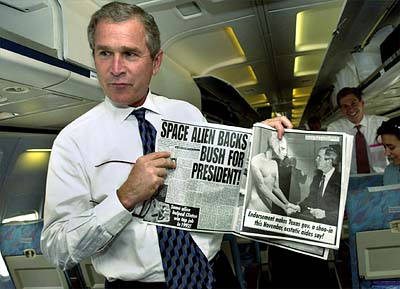 ... Click here for larger image!
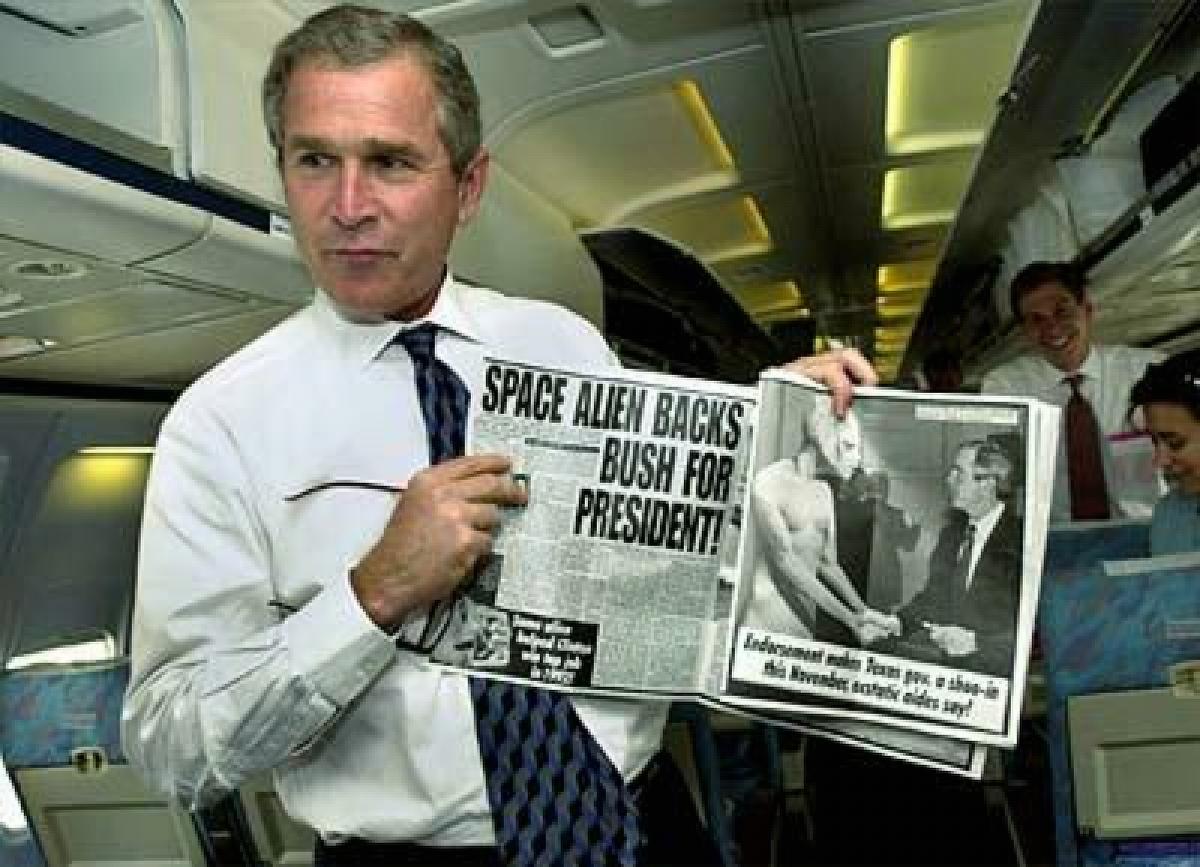
Quoted Bush joking that the alien endorsement demonstrated that "I'm willing to reach across certain demographic lines." (NYTimes, May 8, 2000)
Goal of this course is to help you put the changes you are seeing in the
mass media into broader perspective
-study nature and significance of media revolution
-how have things changed?
-why are changes taking place?
-what do they mean for American society, culture, and politics?
-how does this media revolution affect you?
-how should we evaluate this revolution in communications?
-are the changes good for our country?
Class Approach
-explore media revolution through variety of pedagogic techniques: lectures, videos, discussion sections, and writing assignments
-incorporate videos in class sessions
-students learn in different ways so can't just use one teaching technique
-use lots of case studies that illustrate various problems and controversies
-problem-oriented class (problems of media and possible solutions)
-focus on how to make things better that you are concerned with
Course website: www.InsidePolitics.org (link to PS111)
-has variety of materials online
-syllabus, course concepts, media links, reference materials
-help you studying for final exam
Warning--Controversial Subject Matter
-we will deal with range of controversial matter in this class
a) the media are flashpoint for people of every political perspective (conservatives see liberal bias; liberals think media lets conservatives such as Reagan and Bush get by without detailed scrutiny, and leftists think media are stooge of big corporations)
-some truth to each of these viewpoints, although not nearly to the extent that each political group feels
-shows that everyone feels intensely about some aspect of media behavior
b) the intensity of beliefs creates problems in terms of teaching a course
-wide range of views in this class (future journalists, media critics, people ticked off at how media cover women, minorities, gays, or college professors)
-some love and others hate media
-ask you to be respectful of differences of opinion
-recognize that learning involves listening to others
-some of the things we are going to cover may make you uncomfortable or may even tick you off
-goal is to get you thinking about major issues
Course syllabus
1) office hours
2) required books and course packet
3) media viewing
4) discussion sections
5) writing assignments
6) final exam
7) grading
8) teaching assistants
9) course outline--sequence of topics